


Pushya Nakshatra and Inc*st- Why People Stick to What Feels Familiar in Love
- Shicuki

- Mar 31
- 15 min read
Updated: Apr 12
I analyzed the birth charts of approximately 430 actors portraying characters in films and television who were involved in incestuous dynamics, and Pushya arose as the top nakshatra across the Sun, Moon, and Ascendant combined.

Due to limitations in birth time availability, the dataset includes 245 actors playing characters with sufficiently verified data. However, additional actors without verified birth times will also be discussed in this blogpost, based on their Sun and Moon positions.
This discussion will primarily address consensual sexual dynamics between characters. In cases where non-consensual situations are referenced, the focus will remain on the character experiencing attraction, without examining the perspective of the victim.
To understand why this pattern appears, it is necessary to examine the underlying nature of this nakshatra in detail. In this blogpost, we will explore the structural and psychological tendencies associated with Pushya Nakshatra.
Pushya is often called an 'auspicious' nakshatra, but in approaching this topic, it is necessary to move away from simplistic classifications of nakshatras as auspicious or inauspicious. Such labels are often applied in specific contexts such as muhurta, but they do not adequately capture the full range of expression within a human being. Each nakshatra contains a spectrum of possibilities. Its outcomes are shaped by the degree of balance or imbalance within a person's psyche. Traits that are considered favorable can become detrimental when intensified beyond equilibrium, while traits viewed as unfavorable can produce constructive outcomes under certain conditions.
In the case of Pushya Nakshatra, which is traditionally regarded as auspicious, a disturbance in this equilibrium can result in distortion.
Pushya Nakshatra is placed in the natural 4th house of Cancer. The 4th house signifies the mother, the motherland, the home, and the overall domestic environment. It is associated with private life, and the comforts derived from one’s home.
The ruler of Pushya nakshatra is the Moon, which is associated with commonness in the form of collective patterns and group identity. This introduces an emphasis on similarity and homogeneity within a defined environment. In familial structures relating to the 4th house, there is often an implicit tendency toward uniformity, as shared traits and behaviors contribute to stability and continuity. From a survival standpoint, alignment with one’s immediate environment reduces friction.
In this context, Pushya Nakshatra reflects a strong focus on stability and maintaining the home environment. This often shows up as a need to maintain harmony, even if it means not questioning things too much. There is a tendency to accept authority within the family or cultural setup, especially when it is tied to emotional security. As a result, people with this nakshatra are less likely to challenge what is already in place and more likely to go along with it to maintain comfort and continuity.
There is also a pronounced sense of identification with one’s origins. This can take the form of pride in one’s family, cultural background, or homeland. The attachment is rooted in a deeper psychological alignment with what is familiar.
There is also often an underlying assumption that one’s own background is the most stable or reliable option. This does not always show up as open hostility toward what is different, but it can lead to a consistent preference for what feels familiar. This can develop into a belief that one’s own cultural or familial background holds greater value.
In the movie A Thousand Acres, the father played by Jason Robards (Pushya Sun) sexually abuses his daughters. The movie is very rooted in land and legacy. There’s an unspoken expectation of staying within a familiar social and cultural structure, which decides who belongs and who doesn’t.
In the movie The Sweet Hereafter, the sexually abusive father is played by Tom McCamus (Pushya Sun). The small-town setting also reinforces closed cultural loops, where relationships are shaped by proximity and shared background.

Such a perspective has implications at both psychological and biological levels. From a biological standpoint, the more different the genetic makeup of two parents is, the more likely it is that the offspring will be stronger and more stable overall. Greater variation between parents reduces the likelihood of recessive genetic conditions and supports healthy development. A strong preference for similarity, especially when it becomes limiting, can also work against these advantages by narrowing the range of suitable partners. In extreme cases such as incest, this can result in a much higher risk of serious physical and developmental complications in the offspring.
When populations are small and socially closed, people are more likely to form connections (coercise or consentual) within familiar circles due to limited exposure and opportunity.
The theme of genetic purity can also show up as an extension of this orientation toward familiarity and preservation. In Pushya Nakshatra, this tendency is further reinforced by its deity, Brihaspati, who represents exoteric spiritual authority. As a figure aligned with austerity and higher order principles, Brihaspati represents a form of detachment from personal and relational entanglements. His orientation is directed toward dharma and knowledge rather than emotional or romantic involvement.

In Kabbalah, Jupiter corresponds to the 4th sephira, Chesed, which is associated with loving kindness and stability. The number 4 itself is also often linked with stability, much like a square, where all sides are equal and balanced, creating a sense of grounding and support. Chesed represents a point where energy settles into form and reaches a state of ease or completeness, where movement is no longer necessary.
When something becomes too settled, it can resist change. In Kabbalah, the next sephira, Gevurah, associated with Mars, introduces cutting, and action. It disrupts this comfort and pushes movement forward again.
The combination of being in the 4th house along with the deity being Brihaspati reflects a state of deep comfort and internal stability. In relationships, this can translate into becoming so settled within the home and family structure that there is little drive to seek experiences outside of it even when it comes to fulfilling sexual or romantic needs. Stepping beyond familiar boundaries, whether physically, emotionally, or psychologically, can feel unnecessary or even disruptive.
At its extreme, this tendency toward stability can shift into stagnation. When there is no movement outward, there is also no renewal. While stability provides security, growth requires periodic disruption and expansion, because there is no expansion without change. Without that, the system becomes closed, and over time, this can become a limitation.
This pattern is also reflected in certain spiritual traditions that emphasize withdrawal and singular focus. In the book Kundalini Tantra by Swami Satyananda Saraswati (potentially Pushya Moon), there is an explicit emphasis on minimizing external obligations in order to sustain disciplined practice. He recommends doing so by moving to an ashram where there are no disturbances to spiritual practice, much like the brahmachari nature of Brihaspati. The text highlights how familial and social responsibilities can interrupt sustained spiritual effort, and therefore encourages distance from such engagements. This reflects a broader pattern in austere traditions where external or foreign relationships are viewed as potential disruptions to inner focus.
This orientation can create limitations while forming a relationship, because requires engagement with difference, including differences in habits, values, and perspectives.

The 4th house of Cancer is positioned 12 houses away from the 5th house of Leo. The 5th house is associated with romance, expression, and the act of putting oneself forward in social and relational contexts. Being 12 houses apart creates a dynamic where energy that would normally move outward is instead drawn inward, turning back toward the house itself or the people within it.
This way, there is often less inclination toward conventional dating or the gradual development of attraction through external interaction. The structured nature of dating, with its implicit stages and expectations, may feel misaligned with their natural orientation. This can lead to a withdrawal from typical social avenues where relationships are formed, including events or settings designed for meeting new people.
This tendency is reflected in how Jackie Winkler (@hood.winkler on Instagram), in her video titled How I Manifested My Boyfriend, explained that before meeting her partner, she created a list of qualities she desired in her future partner. In that same video, she shared that she wanted the connection with her life partner to feel like twins, almost like a sibling-like bond. Interestingly, she does not have Pushya Nakshatra herself, but it is her now-fiancé's ascendant nakshatra. In this case, we see it manifesting in non-negative ways, expressing itself as a desire for deep familiarity and comfort within a relationship.
This contrast becomes clearer when compared to nakshatras such as Shatabhisha, Krittika, and Uttara Ashadha, which appeared least frequently in this research. These nakshatras are more oriented toward evolution, broader social interaction, and engagement beyond immediate familiarity. For example, Shatabhisha, being in Aquarius, reflects a tendency to interact across diverse groups and consider wider patterns when forming connections.
Notably, Charles Darwin, whose work on evolutionary theory established the importance of variation and selection, has Uttar Ashadha Moon. This correlation reflects a symbolic alignment between the principle of genetic diversification and the behavioral patterns observed.
Charles and his wife Emma were first cousins. He was anxious about the effects of inbreeding, as several of his ten children suffered from illness or died young, which he feared was a result of marrying his cousin. His concern drove his scientific interest in plant and animal inbreeding.
Since the yoni animal of Uttarashada is the mongoose, which has no partner in the yoni system, there is often little to no desire for a romantic partner in this nakshatra, regardless of where they find this partner. I’ve discussed this dynamic in my Husband Material Zodiac Sign blogpost. Interestingly, this lack of desire is often what draws a partner in the fastest.
The Sun nakshatras, particularly Kritika and Uttarashada, ranked the lowest overall. This can be understood through their inherently logical and fact-oriented way of perceiving the world. Rather than being driven by emotional familiarity or unconscious patterning, these people tend to operate with logical discernment. The Sun is traditionally called the dispeller of darkness and ignorance.
This also indicates that there are typically fewer psychological distortions influencing attraction in these cases, regardless of the level of trauma experienced. It is important to note that such patterns are not inherent or deterministic. Dynamics like incest are more accurately outcomes of trauma or psychological conditioning, and not everyone with Pushya nakshatra will express them in this extreme form.
If we look at this additional graph (below), Virgo stands out as the highest-ranking sign for the Sun, Moon, and Ascendant in this research. This is important because Uttara Phalguni falls largely within Virgo. This likely explains why it was the only Sun nakshatra that did not rank among the lowest in this observation. We will explore the significance of Virgo in this research in more depth in the next part of this series.

Finally, since Pushya Nakshatra is ruled by Saturn while being placed in the sign of the Moon, there is an added layer of control within emotional environments. This combination can bring a need to regulate and structure emotional bonds, which in certain situations may extend into dynamics where control becomes a defining feature.
In the movie The Manchurian Candidate, not only are there themes of incest, but also, the son is controlled both by a chip implanted in his brain, and by his mother’s (played by Meryl Streep, Pushya Ascendant) lifelong psychological dominance, making him an instrument of her political ambition.
Because Pushya Nakshatra is ruled by Saturn, themes of boundaries also become important. In smaller or more closed environments, survival often depends on staying aligned with the group. Opposing beliefs can lead to exclusion, especially where resources and support systems are limited. This creates a strong pressure to maintain sameness, as belonging directly affects security.
In more isolated settings like tightly bound communities, this pressure can become more rigid. Social structures tend to be less flexible, and deviation from accepted norms is less tolerated. Over time, this can create environments where control is both enforced and internalized. In extreme cases, this may contribute to harmful practices as patterns shaped by lack of awareness and restricted exposure to alternative perspectives.
There can be a distortion where boundaries are either overly rigid or improperly dissolved. In cases of familial dysfunction, this can manifest as a breakdown of appropriate limits between family members. When there is underlying trauma, especially within the household, individuals may seek closeness in ways that attempt to compensate for instability or lack of safety.
Among siblings, this can sometimes appear as an intensified bond formed in response to external stress or parental dysfunction. When the home environment feels unstable, the sibling relationship can become a primary source of emotional security. In such cases, the drive for closeness may become excessive, reflecting a need to eliminate any sense of distance.
The blurring of boundaries can be illustrated through the film The Dreamers. In the film, the siblings Isabelle and Theo (played Louis Garrel, Pushya Moon), share an unusually intimate and unstructured dynamic. Isabelle also becomes involved with Matthew, a stranger who is invited into their home.
The film is set during a period of intense civil unrest, with protests unfolding across Paris and even directly outside their home, which further amplifies this breakdown of structure. Isabelle and Theo are already portrayed as unusually comfortable with one another, often sharing space in ways that blur typical boundaries, such as sleeping naked in close proximity. This establishes a baseline where personal and relational limits are already loosened.
This dynamic intensifies in a scene where Isabelle and Matthew engage in sex on the kitchen floor while Theo remains physically present in the same room, casually cooking eggs on the stove, without withdrawing or acknowledging the situation as intrusive.
Another reinforcing factor is the role of secrecy in strengthening interpersonal bonds. When two people share a secret, especially one that is socially prohibited, it can create an intensified sense of connection. The secrecy itself becomes an additional layer of attachment, increasing dependency and limiting the possibility of separation. This dynamic can function as a form of control, where the shared knowledge binds both people into a closed system with reduced external interaction.
At a psychological level, patterns of attraction often reflect unresolved internal states. Repetitive or fixation-based attractions can indicate an underlying sense of lack or incompleteness. These patterns are not driven by the external object alone but by an internal attempt to compensate for something that is perceived as missing. The more this lack is felt, the more persistent the pattern becomes, often without leading to genuine resolution. So even when proximity already exists, it may not be experienced as sufficient.
Early developmental experiences play a significant role in shaping one’s capacity to experience fulfillment. When there is a disruption in formative stages, particularly in relation to play, emotional security, or gradual maturation, the ability to register satisfaction in later life can be affected. This can result in a continuous search for intensity or closeness without a stable sense of completion. The pattern then becomes cyclical, where the pursuit continues without producing lasting fulfillment.
With Pushya Nakshatra, this dynamic can manifest as a persistent sense that existing emotional bonds are insufficient, regardless of their actual strength. Even in stable and close family environments, there may be an underlying perception that the connection could be deeper or more complete. This creates a subtle but continuous sense of lack. The association of Pushya with purity and austerity further intensifies this tendency, as it orients the mind toward an ideal state that is impossible to fully attain. As a result, satisfaction remains partial, and the search for greater closeness continues without a clear point of resolution.
Purva Phalguni is positioned in the middle of Leo, just as Pushya is positioned in the middle of Cancer. Both Cancer and Leo are associated with the heart, though they express it through different principles. Cancer, ruled by the Moon, is linked to the maternal and the emotional foundation, while Leo, ruled by the Sun, is associated with the paternal and the expression of identity. Despite these differences, both signs center around core emotional experience and attachment.
A parallel can be observed in the behavioral patterns of these nakshatras. Pushya is oriented toward emotional security and familiarity within the family, and this orientation does not reach a point of completion. Purva Phalguni reflects a similar structure, but in pleasure and comfort. The pursuit of enjoyment and rest does not culminate in satisfaction. Even in states of ease, there is a perception that greater comfort is still attainable. This creates a pattern of excess without resolution. I discussed this in my Purva Phalguni Man Child YouTube video.
While such outcomes are not universal, the underlying tendency toward unresolved attachment can express itself in more subtle forms as well. In otherwise functional family systems, this may appear as emotional over-involvement, difficulty accepting separation, or possessiveness in response to new relationships. These patterns reflect an extension of the same core dynamic, where attachment does not reach a stable point of fulfillment and continues to seek reinforcement.
At a broader level, fixation-based patterns of attraction often intensify when they are repeatedly acted upon without addressing their underlying cause. The behavior may temporarily create a sense of satisfaction, but over time, it tends to lose its effectiveness. This can lead to escalation, where increasingly extreme conditions are required to produce the same level of response. This is known as the law of diminishing marginal utility in Economics. The pattern becomes self-reinforcing while remaining unresolved at its core.
This mechanism applies across different forms of fixation. When the underlying psychological state is not addressed, it can narrow the range of what produces a response, reducing the capacity to engage with more balanced or conventional forms of intimacy. The result is a cycle in which the threshold for stimulation continues to shift without achieving stability.
In Pushya Nakshatra, the orientation toward the homeland and the mother principle can become so dominant that separation from it becomes difficult. This can manifest in indirect ways, including preferences for roles or structures that create physical or emotional distance from marital relationships. Professions that involve prolonged absence, such as military service, or paths centered on renunciation and withdrawal, may serve as extensions of this pattern. In other cases, the attachment remains within the family system itself, making it difficult to establish independent relational bonds outside of it.
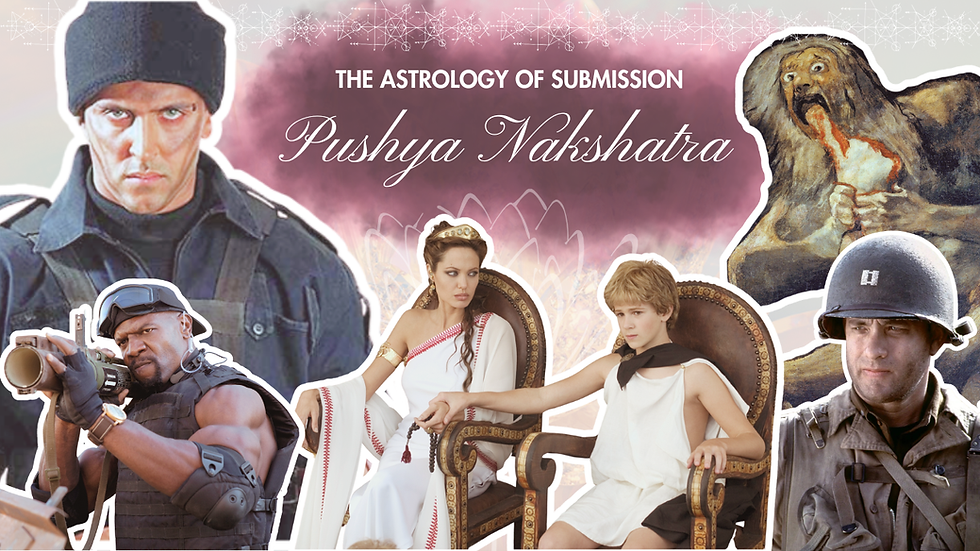
The 4th house rules fortified structures. This is one of the reasons Pushya Nakshatra is often associated with roles connected to protection and service, including military structures, where loyalty to the authority and the homeland is emphasized over personal divergence.
Many notable actors with Pushya Nakshatra have portrayed roles that involve prolonged separation from family, often in the role of a soldier or in similarly mission-driven positions. We see the concept of uniformity and subservience with soldiers as well, which actually helps them greatly in combat. Just like with maintaining harmony in the home, this team spirit actually helps them protect the homeland as well.
These roles frequently depict characters who leave their domestic life for extended periods in order to fulfill a defined objective. The narrative outcomes vary, but they commonly involve either a failure to return marked by significant psychological transformation.

For example, Tom Hanks (Pushya Moon) has taken on multiple such roles across his filmography. In the movies Saving Private Ryan, Cast Away, Apollo 13, Road to Perdition, The Green Mile, Cloud Atlas, Captain Phillips, and Forrest Gump his characters are consistently placed in situations that require distance from home and sustained engagement with external demands. Among these, Road to Perdition presents a trajectory where the character does not return to a stable domestic resolution, while the others involve return under conditions that fundamentally alter the character’s psychological state.
In the movie The Manchurian Candidate, starring Meryl Streep (Pushya Ascendant), soldiers are controlled through implanted brain chips that let handlers override their will and trigger actions on command, making them mindless pawns for the greater agenda.
With Pushya nakshatra, there can be an inclination to move away from the home environment not only due to external obligations but also as a means of avoiding sustained engagement with married life.
This tendency differs from patterns I discussed with Purva Phalguni as well, where instability may appear prior to long-term commitment, often through difficulty in sustaining romantic relationships. In Pushya, the pattern can persist even after entering a relationship. The person may fulfill relational roles at a structural level while remaining psychologically detached, leading to repeated impulses to withdraw or disengage.
The natural 4th house of Cancer is in a position that emphasizes internal security and retreat, which is 10 houses away from Libra and the 7th house, which represents relationships and marriage. This can manifest as a prioritization of duty or external roles over sustained participation in intimate relationships, reinforcing patterns of distance and intermittent withdrawal.
In the series Manifest, Josh Dallas (Pushya Moon) portrays Ben Stone, whose son Cal is diagnosed with cancer. At the same time, Ben is engaged in a complex spiritual dilemma that forms the central premise of the show, where he recognizes that the larger phenomenon he is involved in is directly connected to his son’s healing. This understanding places him in conflict with his wife Grace, who is unable to interpret his actions through the same lens and instead perceives his behavior as withdrawal from the family. While she seeks immediate, conventional solutions, Ben directs his focus toward external developments that are essential to resolving the deeper issue affecting his son.
This is how Pushya nakshatra represents that stage where resolution is sought through withdrawal. Because it is situated in the 4th house, it often resolves relational conflict by withdrawing from the relationship itself. Sometimes, this distancing can appear purposeful and necessary, as seen in the show Manifest. In general life, however, it can also show up as the person stepping away from relational engagement in order to process internal states privately. This may be perceived by a partner as avoidance or disengagement, even when the withdrawal is driven by an attempt to restore stability or address underlying issues at a deeper level.
Coming back to the theme of the 'soldier', the song Army Dreamers by Kate Bush (Pushya Sun) explores themes of duty, and submission to the demands of the nation. The narrative centers on the tension between personal aspirations and the obligations imposed by one’s circumstances. The theme of serving a larger structure, even at personal cost, aligns with the underlying tendencies observed in Pushya Nakshatra.
This, also, can be seen in the show Manifest, starring Josh Dallas (Pushya Moon), where the main storyline is centered around the bond between adult siblings, despite both of them being married to other people. Even when there is no incest present, the emotional focus can remain primarily within the parental family rather than shifting outward.
In the next part of this series, we will go much deeper, where we will examine asexual reproduction in Hydra and other organisms, and how this pattern connects to the underlying themes of Pushya Nakshatra.
In addition, we will look at the concept of matriarchal lineage as it relates to Pushya, in contrast to the patriarchal lineage related with Leo and Magha.
Stay tuned!
![Pushya Nakshatra [Part 3]: The Motherline](https://static.wixstatic.com/media/5640f3_c9e4be1f3ad54e74836bc414cab55763~mv2.png/v1/fill/w_980,h_1386,al_c,q_90,usm_0.66_1.00_0.01,enc_avif,quality_auto/5640f3_c9e4be1f3ad54e74836bc414cab55763~mv2.png)
Comments